
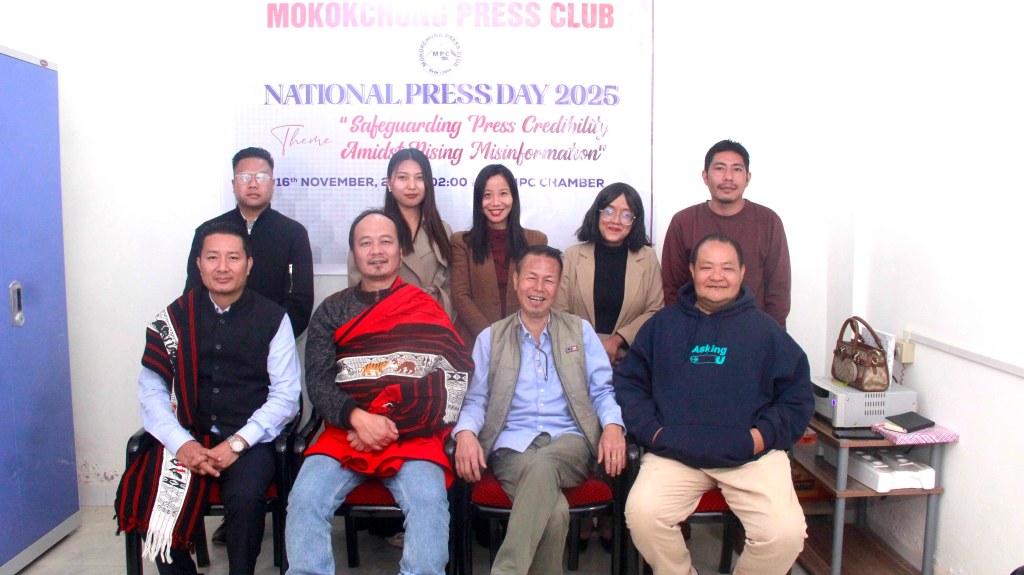
Mokokchung, 16th November, 2025 (Nokinketer.in): The Mokokchung Press Club, supported by the Department of Information & Public Relations (DIPR) Nagaland, observed ‘National Press Day 2025’ on November 16 at the MPC Chamber under the theme “Safeguarding Press Credibility Amidst Rising Misinformation.”
Speaking on the theme “Safeguarding Press Credibility Amidst Raising Misinformation”, Limalenden Longkumer, Editor of Mokokchung Times, said ‘credibility’ is very important. He noted that credibility is built on trustworthiness, and once it is lost, whether for an individual or professionals, there is no foundation to stand upon.
He highlighted misinformation as a major challenge today. Under misinformation, he mentioned fake news, half news, paid news, and many other forms of distorted information. He observed that with smartphones, fake news and false narratives often go more viral than the truth.
Longkumer asked how credibility and the profession can be safeguarded, both as professionals and as journalists. He said he would address the topic in three ways: in general, in the Nagaland context, and in the Mokokchung context.
Speaking in general, he said that to safeguard credibility in an age where misinformation is rapidly generated, journalists must “take deliberate steps” to ensure the media remains trustworthy. In a world filled with half-truths and propaganda, he stressed that every media house must take such steps.
He said that journalists are not influencers or content creators and that virality or instant news should never override accuracy as professional journalists. He cautioned that rushing to publish without proper fact-checking undermines credibility and ultimately harms the very purpose of journalism. Instead, insights, verification, and truth, most importantly verification should guide journalism.
Longkumer stressed transparency and ethics. Without integrity and ethics, press credibility cannot be safeguarded. He noted that fact-checking and follow-up are very important and that journalists must follow up stories till the end to truly enlighten readers and viewers.
He also emphasized editorial independence, saying no media house should compromise its independence. He pointed out that globally and locally, several media houses cater to special interest groups, and when there is no credibility, there is nothing left to safeguard.
He added the importance of media literacy, saying a conscious effort is needed so that people can distinguish truth from falsehood. According to him, journalists must work together to promote media literacy or risk losing credibility, while influencers and content creators are not held to the same standard. He stated that whichever media house one belongs to, accuracy, transparency, and independence are essential, and that no one else will come to build our credibility for us.
Turning to Nagaland, he said journalism here is still functioning with the mindset of the past century. While the world is rapidly changing, Nagaland is still trying to adapt and grow. He mentioned that globally journalism has moved far ahead, whereas in Nagaland “we are still at 5Ws and 1H.” That generation has passed, and journalism now needs context on what impact a story creates and how society reacts to it. He said even a high school student can write a basic 5W report or ask ChatGPT to do it and urged journalists to look at how agencies like the Hindustan Times or PTI work, not to copy them, but to learn the good skills.
He observed a major trend: the proliferation of media houses. He said one major reason behind this rise is paid news, which is illegal, unethical, and self-defeating for journalists. Without ethics and transparency, sponsored content overpowers genuine news, causing a blurring of the distinction between truth and fake news. He explained three types of paid news: political paid news, especially during elections; financial paid news; and corporate paid news, which he said is very difficult to detect.
He warned that accepting paid news would reduce journalists to “presstitutes,” and said that the moment journalists honestly label something as sponsored, their credibility is already lost. He urged concerned citizens to raise their voices against media houses that mislead the public. Hidden sponsorship and paid news disguised as news manipulate public opinion and are illegal. He said journalists must discourage paid news, because if paid news becomes accepted as real news, then there will be no need for journalists.
Speaking on Mokokchung, he mentioned the essence of the Mokokchung Press Club’s establishment and the role it has played with district correspondents in shaping Mokokchung’s media landscape. He cautioned media professionals in the district, saying healthy competition among media houses is necessary.
To safeguard press credibility, he said institutional mechanisms and measures are required from the press fraternity and associations. However, he stressed that if individual journalists fail to uphold credibility, then the profession itself will be lost. Ultimately, he said it comes down to individual journalists. He concluded that if journalists can safeguard credibility at an individual level, then the purpose of celebrating this day will be meaningful. He pointed out that this problem has no foreseeable end.
In his Presidential Address, Sashimeren noted that it is timely amid rising misinformation on social media. He questioned whether journalists should work based on the expectations of leaders or focus on grassroots realities to uphold press credibility. Calling the press the fourth pillar of society, he urged members to commit to truth and acknowledged the profession’s ongoing challenges of maintaining independence and trustworthiness.
The programme was chaired by Imnatola. A Q & A session, moderated by Tsüngtaluba Imchen, allowed members from the MPC to engage in discussions on media ethics and challenges faced by journalists in the digital era. The event concluded with a vote of thanks from Imnawapang Jamir, Finance Secretary of MPC.
*****
 The Nokinketer