
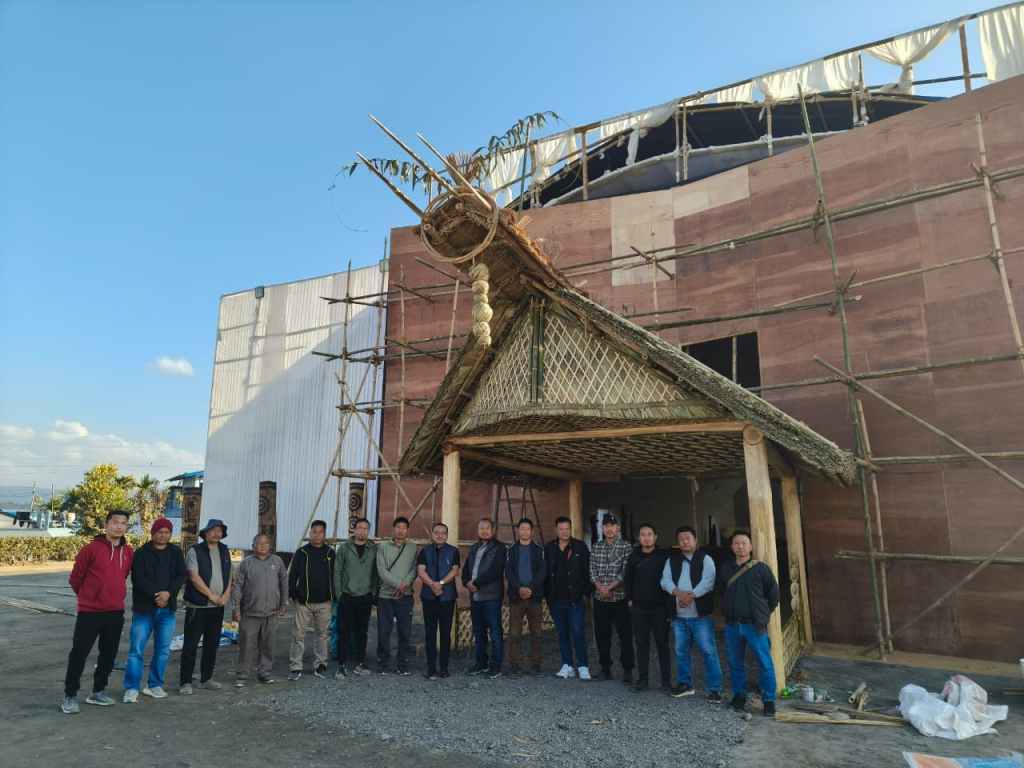
Mokokchung, 10 January, 2026 (www.nokinketer.in): Lanutoshi Aier, President, Ao Kaketshir Mungdang (AKM), and Tsüknungtemsü, President, Chungtia Students’ Union, in a press conference held on 10th January at Chungtia village, informed that the 70th AKM General Conference will be held at Chungtia village from 13 to 15 January 2026.
Tsüknungtemsü informed the media that the Chungtia Students’ Union and Chungtia Village Council have been preparing for the conference for the past nine years. They have invited 1,700 delegates, who will be hosted by nearly 700 families of Chungtia village. A conference hall with a seating capacity of 2,200 has been constructed for the event. Transportation arrangements include the provision of seven buses for delegates.
Lanutoshi Aier informed that S. Supongmeren Jamir, Member of Parliament, Lok Sabha, will attend as the Inaugural Guest, while the Nagaland Chief Minister, Dr. Neiphiu Rio, will be the Chief Guest. The closing guest will be T.N. Mannen, Advisor & MLA, Law and Justice, Land Revenue, Government of Nagaland. Other dignitaries and special invitees scheduled to attend the conference include Metsübo Jamir, Minister, Rural Development & SIRD, Government of Nagaland; Temjenmenba, Advisor & MLA, Transport and Technical Education, Government of Nagaland; M. Imkongla Jamir, IAS, Resident Commissioner, Government of Karnataka, New Delhi; and Limasunep Jamir, IPS, Special Secretary, Home, Government of Nagaland.
The AKM President further informed that a panel discussion on the theme “Navigating Education, Politics, Media, Religion and Entrepreneurship in a Changing World” will be held during the conference. The panellists include Imkongnükla Ao, EAC, Longleng; Lanuwabang, Director, NIELIT, Kohima, Government of India; K. Temjen Jamir, Editor, Tir Yimyim; and Rev. Dr. Wati Aier, Convenor, FNR.
He also mentioned that an Ao Spell Bee Competition will be organized with the aim of preserving the Ao language among younger generations. Additionally, a magazine featuring articles on various contemporary issues beneficial to student delegates will be released during the event.
Lanutoshi also said, “The conference will be held on the theme ‘Strengthening Horizons’, which emphasizes broadening perspectives, strengthening values, and equipping young people to navigate a rapidly changing world. All student delegates are requested to be mentally prepared to learn from one another and to participate in a positive and constructive manner throughout the conference.” The 70th edition of the AKM Conference will be telecast live on the AKM YouTube channel.
Chungtia is one of the oldest and most historically significant Ao Naga villages in Nagaland, renowned for its deep-rooted indigenous spirituality, sacred landscapes, and unbroken living traditions of culture and community institutions. As per the 2011 Census, the village has a population of 4,661 (2,408 males and 2,253 females) and boasts an impressive literacy rate of 86.12% (higher than the state average), with male literacy at 88.39% and female literacy at 83.68%. Located just 15–16 km northwest of Mokokchung town, Chungtia is easily accessible via NH-702D (the Mokokchung-Mariani Highway), which passes through its eastern edge.
The village boasts several important heritage sites that reflect its rich Ao Naga legacy, embodying centuries of indigenous spirituality, warrior traditions, and communal history. Here are some of the key ones:
- Tüvlong — A significant traditional or sacred site tied to the village’s cultural and historical narratives.
- Yimpang Sungkum and Sungkum Api — Revered spots often linked to ancestral rituals, community gatherings, or sacred geography in Ao Naga folklore.
- Yimrongdong — Another heritage landmark preserving elements of the village’s spiritual and social heritage.
- Arijuma Tzütu — A culturally important place reflecting the deep-rooted indigenous beliefs and sacred landscapes of Chungtia.
- Tongden (the traditional Log Drum) — Perched proudly on a hilltop, this iconic symbol represents the village’s warrior past and serves as a powerful emblem of bravery, unity, and historical resilience. In Ao Naga culture, log drums were once considered the “voice” of the village, sounded during celebrations, emergencies, and communal events.
(www.nokinketer.in)
 The Nokinketer