
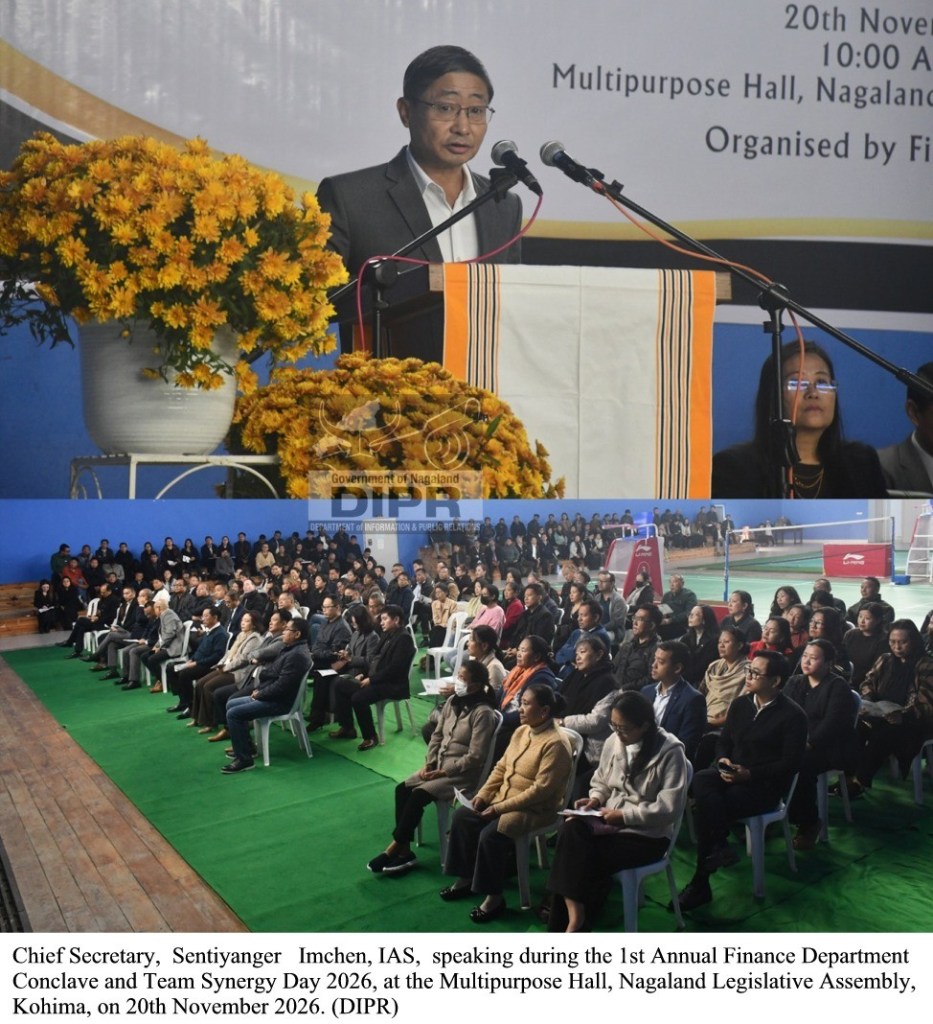
Kohima, 20th November 2026 (Nokinketer News): The Finance Department, Nagaland, held its first Annual Finance Department Conclave and Team Synergy Day 2026 at the Multipurpose Hall of the Nagaland Legislative Assembly, Kohima, on Friday, bringing together senior officials and policymakers to deliberate on the state’s financial management and strengthen coordination within the department.
Addressing the gathering, Chief Secretary Sentiyanger Imchen, IAS, said the conclave provided an important platform for discussions on Nagaland’s finances and economy while fostering greater synergy and cohesion among the different wings of the department.
Emphasising the need for effective financial management in a resource-constrained state like Nagaland, Imchen called for a clear vision and roadmap to augment revenue, plug loopholes and leakages, and ensure efficient delivery of public services. He stressed that planning must be backed by effective implementation, coordination and convergence among the various wings of the department.
Highlighting the role of technology in governance, he pointed to the integration of systems such as NIFiMS, TreasuryNET and e-Bill, along with national platforms including PFMS and SNA-SPARSH. However, he observed that technology and regulations alone could not overcome institutional barriers, identifying resistance to change and inter-departmental differences as major challenges to effective coordination.
He underscored the importance of soft skills, including empathy, clear communication, collaborative problem-solving and adaptability, in building a cohesive and effective team. He also urged government officials, particularly senior officers, to embrace change, move beyond conventional mindsets and become catalysts for progress in keeping pace with technological advancements and modern governance practices.
Referring to Nagaland Vision 2030, the Chief Secretary stressed the need to move beyond identifying problems and bottlenecks towards developing practical solutions and ensuring their effective implementation.
Delivering the opening remarks, Finance Commissioner Kesonyü Yhome, IAS, said the conclave was organised to bring the department onto a common platform for interaction, knowledge-sharing and collective introspection.
Highlighting the department’s crucial role in governance, Yhome said its responsibilities extended beyond regulation to ensuring that public resources were efficiently allocated and translated into tangible developmental outcomes.
Pointing to Nagaland’s fiscal challenges, including limited revenue generation, infrastructural constraints and heavy dependence on Central funds, he stressed the need to mobilise additional resources while strategically utilising existing funds to lay a strong foundation for a developed Nagaland by 2047.
He also called for modernising departmental operations through digital systems and data-driven decision-making to improve financial forecasting, expenditure planning, cash management and transparency. Stronger coordination among administrative departments and agencies, including Treasuries, Lotteries, Taxes and the Accountant General’s Office, was also emphasised to enable timely policy interventions and better financial management.
Speaking on the theme of Team Synergy, Yhome observed that institutional effectiveness ultimately depended on its people. He called for a collaborative working culture in which senior officers shared their experience, younger employees contributed fresh ideas, and robust systems ensured the preservation of institutional knowledge.
He urged participants to use the conclave as an open platform to identify administrative bottlenecks, simplify procedures and strengthen professional relationships within the department.
Concluding his address, Yhome reminded officials that they were custodians of public resources belonging to the people of Nagaland and must discharge their responsibilities with commitment and accountability. He also expressed appreciation to the Chief Secretary for attending the programme and acknowledged his earlier leadership as Finance Commissioner in laying the foundation for important financial policies in the state.
*****

