
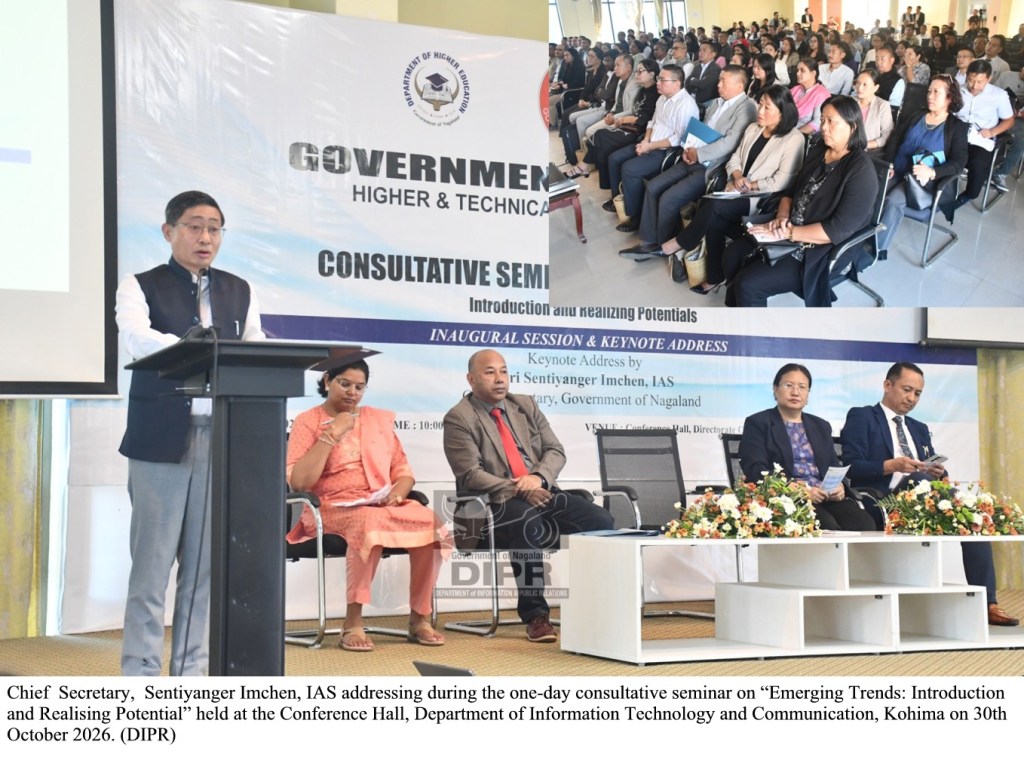
Kohima, 30th October 2026 (Nokinketer News): Chief Secretary Sentiyanger Imchen, IAS, has called for a major shift in Nagaland’s higher education system, urging universities and colleges to introduce emerging, industry-oriented courses to bridge the growing gap between academic qualifications and employment requirements.
He was delivering the keynote address at a one-day consultative seminar on “Emerging Trends: Introduction and Realising Potential”, organised by the Department of Higher and Technical Education at the Conference Hall of the Department of Information Technology and Communication on Friday.
Imchen said rapid technological advancements, artificial intelligence, automation, climate change and the green transition were transforming the global education and employment landscape. He pointed out that an overemphasis on conventional academic education had resulted in many graduates possessing theoretical knowledge but lacking practical skills required by employers.
Highlighting Nagaland’s employment scenario, he said government employment opportunities had become increasingly limited, with recruitment through the NSSB and NPSC standing at 845 in 2024 and 589 in 2025. Citing the Periodic Labour Force Survey (March 2026), he said unemployment among the 15–59 age group stood at 7.3% in Nagaland against the national rate of 3.5%, while youth unemployment was 17.5% compared to 9.9% nationally.
He further cited a 2025 report on unemployment, skills and migration in Nagaland, which found that 92% of residents lacked formal vocational or technical education and 78% of workers had no prior work experience, underscoring the gap between academic learning and job-market readiness.
Urging educational institutions to introduce programmes in artificial intelligence, data science, cyber security, renewable energy, agriculture and other emerging fields, Imchen said faculty shortages and infrastructure constraints should not hinder progress. He suggested faculty-sharing arrangements, institutional collaborations, industry partnerships and hybrid learning as possible solutions.
He also welcomed Nagaland University’s initiative to incorporate AI components into postgraduate and PhD programmes from the 2026–27 academic session and urged private universities, colleges and technical institutions to follow suit.
Secretary of Higher and Technical Education, Sarita Yadav, IAS, in her welcome address, stressed the need for educational institutions to keep pace with emerging technologies, changing industry requirements and evolving career opportunities. She said the seminar would promote informed academic choices and create awareness among students about future employment prospects.
Pro Vice-Chancellor of Nagaland University, Medziphema Campus, Prof. Dipak Sinha, in his special address, said emerging courses need not always mean introducing entirely new programmes but could also involve updating existing curricula to meet changing technological and market demands. He stressed that AI should be integrated across disciplines rather than restricted to computer science.
He also highlighted opportunities in agriculture and allied sectors, informing that Nagaland University had approved five agriculture-related skill enhancement courses. He encouraged institutions to promote short-term certificate courses, faculty training, practical learning, career guidance and industry collaboration.
The seminar featured technical sessions on green and renewable energy; agriculture, veterinary sciences and livestock; artificial intelligence, machine learning, Internet of Things, smart technologies, cybersecurity, semiconductors and data science; medical science technologies; and emerging pedagogies in arts and commerce.
The sessions were delivered by Assistant Professor Dr. M. Prakash, Prof. Dipak Sinha, Joint Director of NIELIT Er. Morimenba, Deputy Director of Health and Family Welfare Dr. S. Yingnei Konyak, and Principal of SCTE Dr. Alemla Longkumer.
*****

