
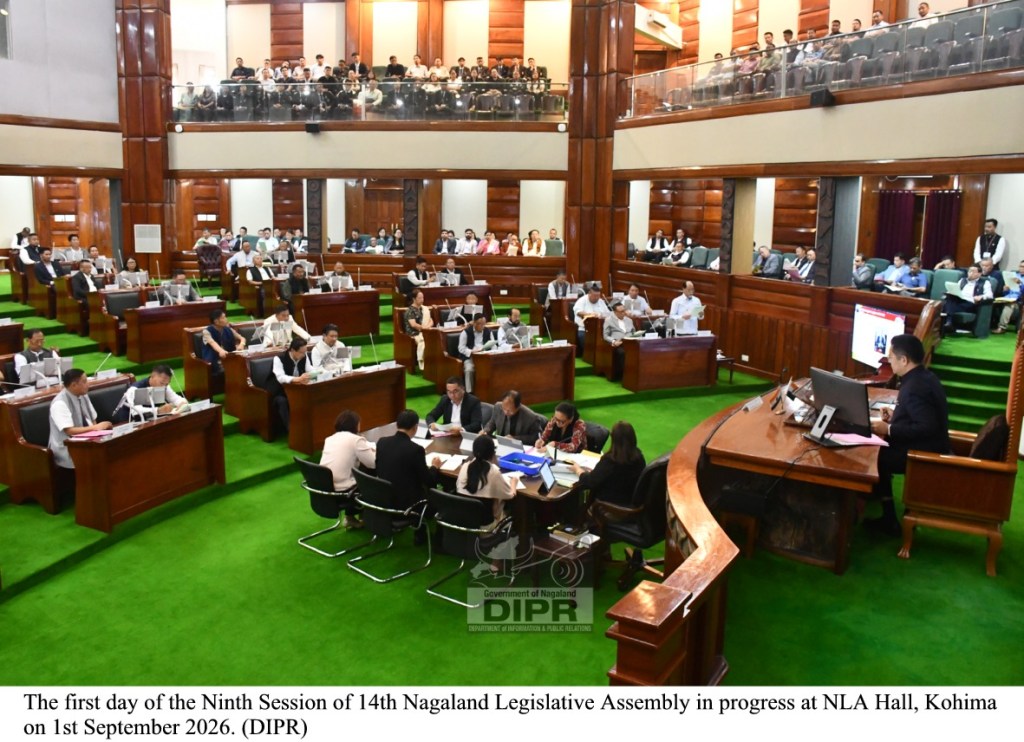
Kohima, 1st September 2026 (Nokinketer News): Advisor for SCERT & Food Processing Achumbemo Kikon on Tuesday initiated a discussion on a matter of urgent public importance under Rule 50 of the Nagaland Legislative Assembly, raising concerns over the proposed amendments to the Foreign Contribution (Regulation) Act (FCRA), 2010, during the ninth session of the 14th Nagaland Legislative Assembly.
Initiating the discussion, Kikon said the proposed amendments could introduce stringent regulatory measures, including cancellation of FCRA registrations and possible government control over assets created wholly or partly through foreign contributions.
Referring to Nagaland’s unique context, he said churches and church-affiliated organisations have historically played a vital role in education, healthcare, social welfare, poverty alleviation and community development across the state.
Kikon cited concerns expressed by the Nagaland Baptist Church Council (NBCC), the North East India Christian Council (NEICC) and other church bodies, particularly over the renewal of FCRA registrations and the proposed powers to be vested in the designated authority.
He urged the Centre to uphold the principles of natural justice and due process by ensuring adequate opportunities for organisations to present their views. He also called for a broad-based consultative process involving state governments, churches, civil society organisations and development agencies before finalising the proposed amendments.
Kikon further sought careful constitutional scrutiny of the proposed legislation in the context of Article 371A, especially provisions relating to Nagaland’s religious and social practices.
Participating in the discussion, Advisor Temjenmenba highlighted the role of churches and Christian organisations in Nagaland’s social development for over 150 years.
He said that long before government institutions reached many remote areas, churches had already been providing education, healthcare and social welfare services across the state.
While acknowledging the need to regulate foreign contributions, Temjenmenba said transparency, accountability and national security were legitimate concerns. However, he stressed that implementation of the law should not adversely affect genuine charitable and developmental organisations.
He added that the enforcement of the FCRA should take into account Nagaland’s unique historical, social and developmental circumstances, given the longstanding contributions of churches and civil society organisations.
MLA Y. Mankhao Konyak said the proposed FCRA Amendment Bill, 2026 seeks to establish a legal framework to supervise, manage and dispose of assets of NGOs that fail to renew their FCRA registration.
He expressed concern that the Bill could adversely affect faith-based and charitable organisations working in education, healthcare, disaster relief and poverty alleviation, particularly in remote and economically weaker regions. He said there were apprehensions that the proposed provisions could lead to confiscation or government takeover of assets, placing minority institutions and independent welfare organisations under greater central oversight.
Konyak said Christian-run institutions, including schools, hospitals and homes for the destitute, which have contributed significantly to the state’s development, could be among those most affected.
He further said the Bill lacked a transparent and clearly defined procedure for renewal of FCRA certificates, leaving room for arbitrary decisions. Pointing out that the proposed legislation offered no provision for appeal or a second opportunity in cases of delayed renewal, he urged that any amendment should ensure a simple, affordable and transparent renewal mechanism.
MLA Kudecho Khamo also voiced concern that the proposed amendments could impose additional regulatory burdens on churches, charitable institutions and civil society organisations, especially smaller organisations engaged in humanitarian, educational, healthcare and community development activities.
While supporting the government’s objectives of promoting transparency, financial accountability and national security, Khamo said the legitimate interests and contributions of churches and charitable organisations should be safeguarded. He urged the Centre to continue consultations with stakeholders and to consider their concerns while examining the proposed legislation, in keeping with the principles of justice, equality and secularism.
MLA P. Longon also participated in the discussion.

