
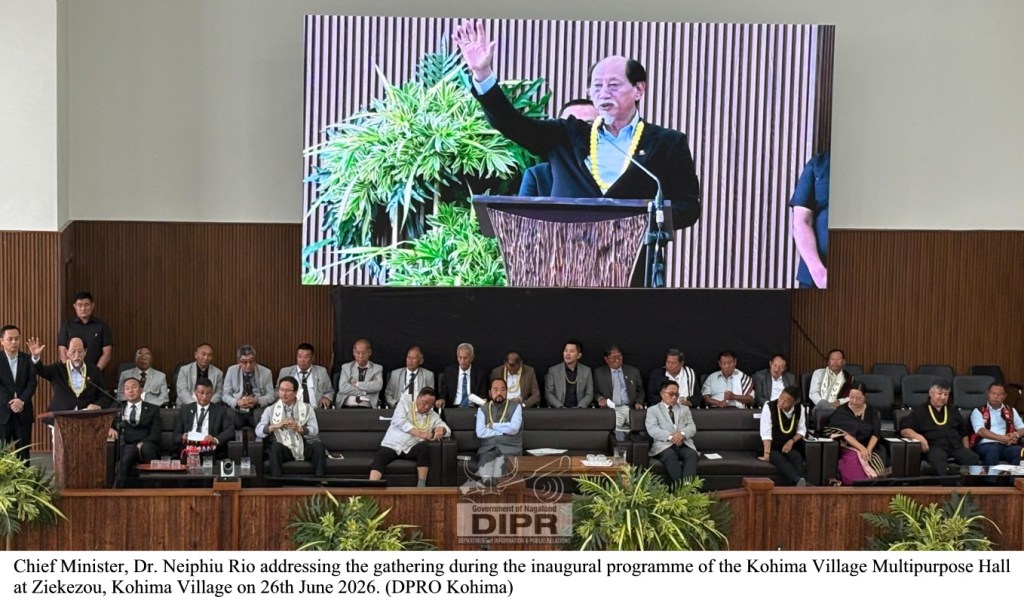
Friday, 26 June 2026 (Nokinketer News): Chief Minister Dr. Neiphiu Riocalled for unity among Nagas, protection of indigenous identity, and collective responsibility in ensuring an accurate Census 2027 while inaugurating the Kohima Village Multipurpose Hall at Ziekezou, Kohima Village in Kohima on 26th June 2026.
Describing the occasion as “historic,” Rio said the newly inaugurated multipurpose hall was not only an asset for Kohima Village but a facility for all Naga communities and organisations to foster unity, goodwill, and brotherhood. He expressed happiness that the project was supported through funds from the Ministry of Tribal Affairs, with additional assistance from the State Government, enabling the construction of a landmark building envisioned as a common platform for the people.
Congratulating the Kohima Village Council, Rio credited the successful completion of the project to the unity, dedication, and prudent utilisation of government funds by the village. He said the achievement reflected the collective spirit of the village and would serve generations to come.
Sharing his personal connection with Kohima, Rio recalled that his family moved to the town during the insurgency in the mid-1950s. He said he completed his education in Kohima and has continued to live there, adding that his family has developed deep bonds with the people of the village through friendships and intermarriages.
The Chief Minister praised Kohima Village for its inclusive nature, saying its welcoming attitude towards people from different backgrounds had contributed to its growth into what is regarded as the largest indigenous village in Asia.
Highlighting Nagaland’s unique traditional institutions, Rio said the British administration had recognised the distinct identity, customs and self-governance systems of the Nagas, leading to the enactment of the Bengal Eastern Frontier Regulation, 1873, which introduced the Inner Line Permit system. He noted that these constitutional safeguards continue today under Article 371(A) of the Constitution of India.
Emphasising the importance of village councils, Rio said Nagaland was exempted from the 73rd Constitutional Amendment because of its traditional system of local governance. He explained that village councils function through consensus-based selection rather than electoral contests, preserving unity within villages and preventing divisions.
On the Registration of Indigenous Inhabitants of Nagaland (RIIN), Rio said the exercise was introduced to protect the rights of indigenous Nagas after instances where indigenous certificates had allegedly been issued to non-Nagas. He clarified that while Indian citizens from other communities are free to reside and work in Nagaland, indigenous status is reserved for native Naga communities. He added that village councils remain the competent authority to certify indigenous inhabitants of their respective villages.
The Chief Minister also stressed the need to regulate the influx of migrant workers while simultaneously equipping local youth with skills to take up employment opportunities. He encouraged young people to avail themselves of government-supported skill development, entrepreneurship schemes, and financial assistance programmes, including collateral-free loans and interest subsidies.
Turning to Census 2027, Rio urged all sections of society, including village councils, churches, tribal hohos, urban local bodies, civil society organisations, and community leaders, to ensure that the upcoming census is conducted honestly and accurately.
He recalled that Nagaland had rejected the 2001 Census due to abnormal population growth figures caused by inflated enumeration, while the 2011 Census recorded a decline in population. He said inaccurate census data had adversely affected planning, allocation of resources, education, and welfare schemes, and called upon citizens to ensure that the 2027 Census reflects the true demographic picture of the State.
“The data we provide today will determine the future of our children for decades to come,” Rio said, appealing for active public participation in the census process.
Concluding his address, the Chief Minister thanked the Kohima Village Council for opening the multipurpose hall to all communities and organisations, saying the facility symbolises unity, cooperation, and the shared aspirations of the Naga people.
Host of the event, Advisor for School Education, Dr. KekhrielhoulieYhome highlighted Kohima Village’s historical significance and its contribution to the growth of Nagaland, while noting the socio-economic pressures faced by the indigenous community due to rapid urbanisation. He said the newly inaugurated multipurpose building, constructed with government support, is meant to serve all Nagas and provide a venue for community gatherings, meetings and cultural programmes.
The programme was attended by Ministers, Advisors, MLAs, AHoDs, HoDs, tribal leaders and others.
Earlier, the programme commenced with the unfurling of the Kohima Village Council (KVC) flag by the Chief Guest, followed by an invocation offered by Rev. Dr. Ruokuovilie Sachü, Senior Pastor, KBK. Dr. Rio also unveiled the commemorative monolith marking the inauguration of the building.
Chairman of the Kohima Village Council, Helievi-o Solo, delivered the welcome address, while MedophrenuoYiese presented a special number “Kewhizou”. A report on the construction of the Kohima Village Multipurpose Building was also presented during the programme. The programme also featured a folk song by Lidi Kro-u. Words of gratitude were delivered by K. Neibou Sekhose, Convenor of the Organising Committee.
*****

